
Crisis Management Advisor & Media Trainer
I’m Jeanette Fors-Andrée — a crisis management advisor and media trainer based in Stockholm, Sweden, and the founder of Jeanette Fors-Andrée AB. For over two decades I’ve worked with reputation crises and crisis communication, building deep, hands-on experience of complex crises, media scrutiny, and the media training of spokespeople for their most critical moments.
I guide organisations through reputation crises every day, and I prevent or contain media firestorms. I media-train spokespeople continuously and advise organisations through media scrutiny — with one aim: to identify the danger fast, limit the damage, and stop crises and headlines from escalating into full-blown scandals.
I work primarily in Sweden and the Nordics, and I’m open to assignments across Europe — in English, and Swedish.
My view on reputation crises
I define a reputation crisis as the reputation gap — the mismatch between words and action. The imbalance between what you say you’ll do, or what others expect you to do, and what you actually do. Reputation crises escalate out of broken promises and unfulfilled expectations.
You can never buy trust. You have to earn it. And you earn it by keeping your promises and managing other people’s expectations well. That is my starting point.
It doesn’t mean you have to get everything right. None of us are flawless. Missteps happen. We can’t insure ourselves against our own mistakes, or other people’s. We can’t insure ourselves against what happens around us. And we can’t insure ourselves against the scrutiny, the accusations, or the necessary-but-difficult decisions that provoke serious reactions. But it’s when something has gone wrong that we have the chance to do right. Often it isn’t the revelation or the event itself that creates the reputation crisis — it’s how you handle the situation in front of you.
As the media climate has grown more brutal, crisis management and media training have only become more important. Many chief executives and senior leaders experience a media climate increasingly defined by a fixation on individuals, sensational headlines, and the hunt for the quick click. And yet the same mistakes are made again and again.
One of the most common is to meet scrutiny with your hackles up — to fall into a destructive defensive posture that obstructs and delays the work of managing the crisis. As a leader or representative of an organisation, you tend to wait far too long before dealing with the underlying problem. That is exactly what lets a crisis escalate into a scandal.
Another common mistake is to submit to the drama of the media — to become a passive victim instead of consciously shaping how you’re portrayed and taking control of your own narrative. You walk into media situations unprepared. You fall into the classic traps, and feed an even fiercer media drama in the process. Only afterwards do you realise that media logic doesn’t follow the logic you’re used to, and that, with hindsight, you should have acted differently.
As a media trainer, I want to give you the courage to own your agenda: to set your own terms and your own boundaries in a media climate that is tougher than ever. The courage not to submit to rules someone else has written — and the concrete tools you need to influence how you’re portrayed. Remarkable things happen when you have the tools to turn yourself from interview victim into interviewee.
Never crisis-manage yourself
One more lesson from over twenty years of reputation crises and crisis communication: the importance of asking for help. Crisis management is a deeply complex process that few people have any hands-on experience of.
Even the most media-savvy person gets tunnel vision when the problems pile up — when the famous reptilian brain takes over and you can no longer think clearly or make wise decisions. When all you want to do is flee and hide. When the human defence mechanism makes you want to shut the door, put a lid on it, bury the questionable dealings, and lie when the truth catches up. When it feels impossible to say what’s happening, when you want to shout at the journalists and vent your frustration. When your mouth goes dry and the anxiety hammers in your chest. That is the moment to bring in help — because one important truth is that you should never crisis-manage yourself. It’s about as constructive as reaching for the scalpel to take out your own appendix.
Asking for help isn’t a sign of weakness. It’s a sign of strength. There’s nothing morally or rationally wrong with bringing in professional help when an organisation’s reputation and credibility are at stake. When the business is at its most fragile. When panic and the fear of getting it wrong fill the boardroom. When owners, customers, consumers, employees, and the public expect transparent, honest answers — and when the media demands clear ones. That’s when you need an outside perspective. External support with the nerve to be brutally honest, to question decisions, and to voice uncomfortable truths. Someone with long, practical experience of processes as complex as crisis management and media training.
My background
I work right across the spectrum — from a quarter of the companies on the OMXS30 (the index of the thirty largest listed companies on the Stockholm stock exchange) to the smaller, newly launched tech company. In other words, I’m engaged by everyone from global brands and listed companies to growth companies, idea-driven organisations, industry associations, public-sector bodies, and public figures.
As head of crisis and media management at the food industry’s trade association within the Confederation of Swedish Enterprise, I supported Swedish companies and management teams with acute crisis management and media training every day. Brought in to rebuild confidence in the wake of the European horse meat scandal, I led work that helped raise public trust in the industry from 63% to 85% — and the association became the first in Sweden to establish a dedicated crisis-and-media function and to adopt crisis guidelines that now set the standard for the sector.
Before that, I was a PR and crisis consultant at Hill+Knowlton Strategies, the global communications agency, where I advised Swedish and international clients and ran the agency’s crisis team. For seven years I also studied reputation crises and crisis communication at academic level, as a researcher at Uppsala University — which is why I’m described as Sweden’s most academically trained crisis expert. And I lecture in crisis communication, crisis management and media logic at Berghs School of Communication, named the world’s best communication school, where my teaching averages 4.83 out of 5.
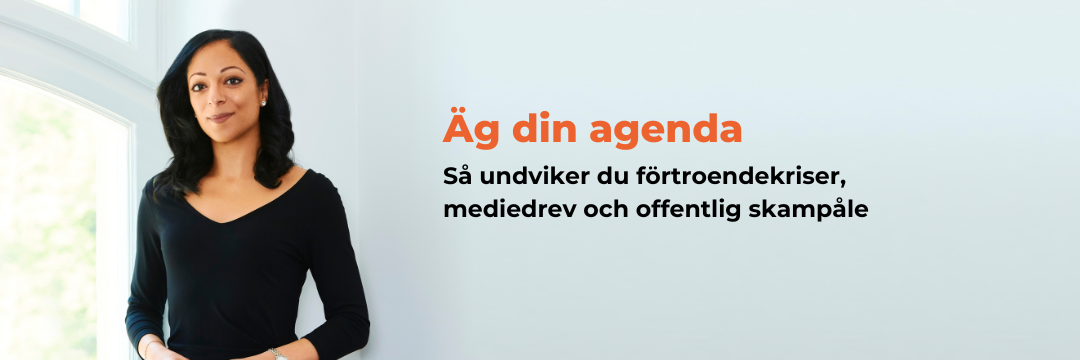
At the end of 2021 my most recent book was published: Äg din agenda (“Own Your Agenda: How to Avoid Reputation Crises, Media Firestorms and Public Shaming”).
Recognition
My work is regularly recognised within the Swedish communications industry. In early 2026, the industry magazine Resumé named me one of Sweden’s most influential women — noting that my influence is most tangible when the storm is fiercest, and that I’m the person the country’s most powerful turn to in order to save their reputations in a media disaster. The same magazine has ranked me among the people who have most shaped the industry over the past decade, and in 2019 I was named Communications Consultant of the Year for helping to demystify the media and showing the way for a new generation of transparent crisis and media advisers.
Work with me
If your organisation is facing media scrutiny — or you want to be ready before it comes — get in touch. Based in Stockholm, I work primarily in Sweden and the Nordics, and I’m open to assignments across Europe, in English and Swedish, by video call or on site wherever the situation calls for it.
Jeanette Fors-Andrée AB
Phone: +46 708-93 50 07
Email: jeanette@forsandree.se